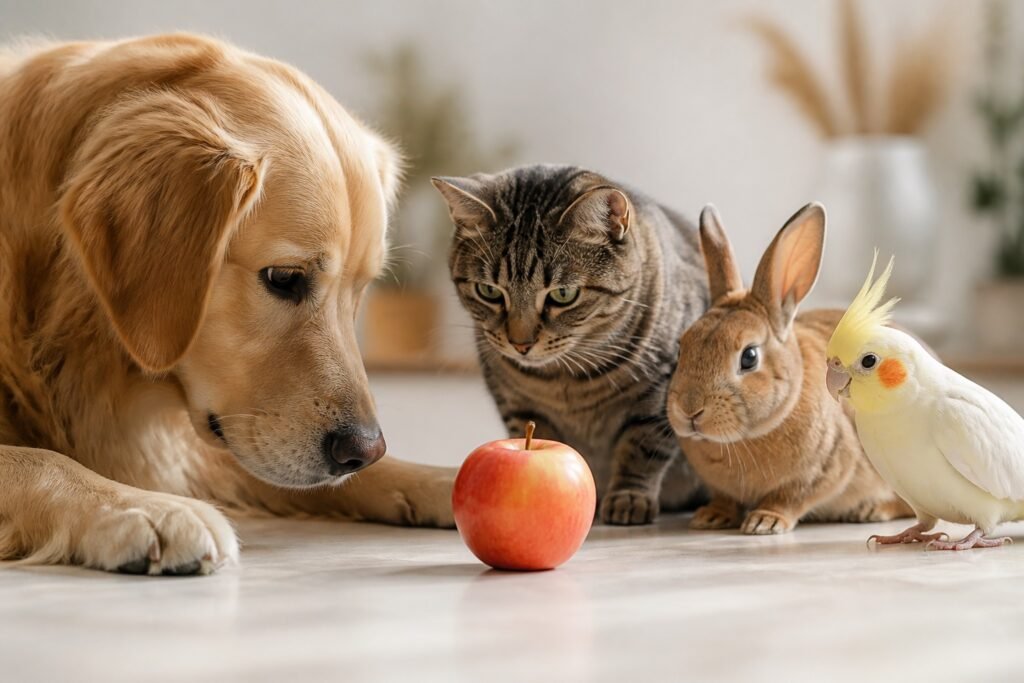
The seedless, heartless apple can be an occasional crunchy treat for dogs, rabbits, and many birds; the heart and seeds are always removed.
The pulp provides water, fiber and a flavor that many dogs accept well. The problem is in the heart and seeds: they contain cyanogenic compounds in small amounts and are a choking hazard if swallowed whole.
Don't offer cake, sugary sauce, or caramelized apple. In cats the benefit is minimal. In rabbits, an occasional fine piece; hay is still the base.
Seedless and heartless.Cut into the right size pieces. If you choke or swallow a large amount of seeds, contact your veterinarian.
How to offer it
- Lavaand remove heart and seeds.
- Piecesthat do not choke; in small dogs, thin sheets.
- No Skinif there is a sensitive belly (optional).
- Avoidsugary compotes and apple pastries.
Editorial criteria for deciding
Before offering any human snack, answer three questions: does this species digest this format well?, is the amount a reward or is it displacing the entire diet?, is there disease, extreme age or medication that changes the risk? If any answer is doubtful, don't improvise.
- Observe 24–48 hafter the first minimal test: stool, vomiting, itching, apathy or refusal of food.
- 17. Count caloriesof the prizes within the daily total; the repeated “just a chunk” gets fatter.
- Guarda toxics(chocolate, xylitol, grapes, alliums, alcohol, raw dough) out of curious snouts.
- Before dangerous ingestion, contact veterinarian or toxicology with estimated weight and amount/hour.
Remember that Faunexia's food files are multi-species editorial guidance: the verdict of the table and the dose per species weigh more than anecdotes of networks. When the risk is asymmetrical (safe in one species and dangerous in another), do not generalize.
Preparation, storage and warning signs
Safety doesn't end at the plate: how you store debris, whether you leave cobs or bones in accessible trash, or whether you mix leftovers with onion/garlic determines much of the actual urgency. A badly presented “acceptable” food (salt, sauces, sweeteners, fermentation) is no longer acceptable.
- Method:simple cooking where appropriate; no salt, butter, sofrito or sauces.
- Storage:trash lid and countertops; dogs steal barbecues and buckets.
- Signals:repeated vomiting, bloody diarrhea, apathy, tremors, difficulty breathing or absence of stool/urine according to species.
- Action:write down time and estimated amount; contact veterinarian/toxicology. Do not induce vomiting without indication.
- Prevention:educates cohabitants and visitors: do not feed from the table without criteria.
If your animal has a therapeutic diet (renal, hepatic, gastrointestinal, urinary), any new snack must pass through the discretion of your veterinarian: what is "safe" in a healthy adult may be inadequate in pathology.
Frequently asked questions
Green or red apple?
Both are good if you remove seeds; prioritize small portion.
with skin
Many dogs digest it; if there is diarrhea, try without skin.
JUICES
Concentrated sugar without chewing: not recommended.
Daily
No need. Alternate with other low-calorie treats.